
Safety & Moderation Standards | MyINC Social

Security & Trust

Safety & Moderation Standards

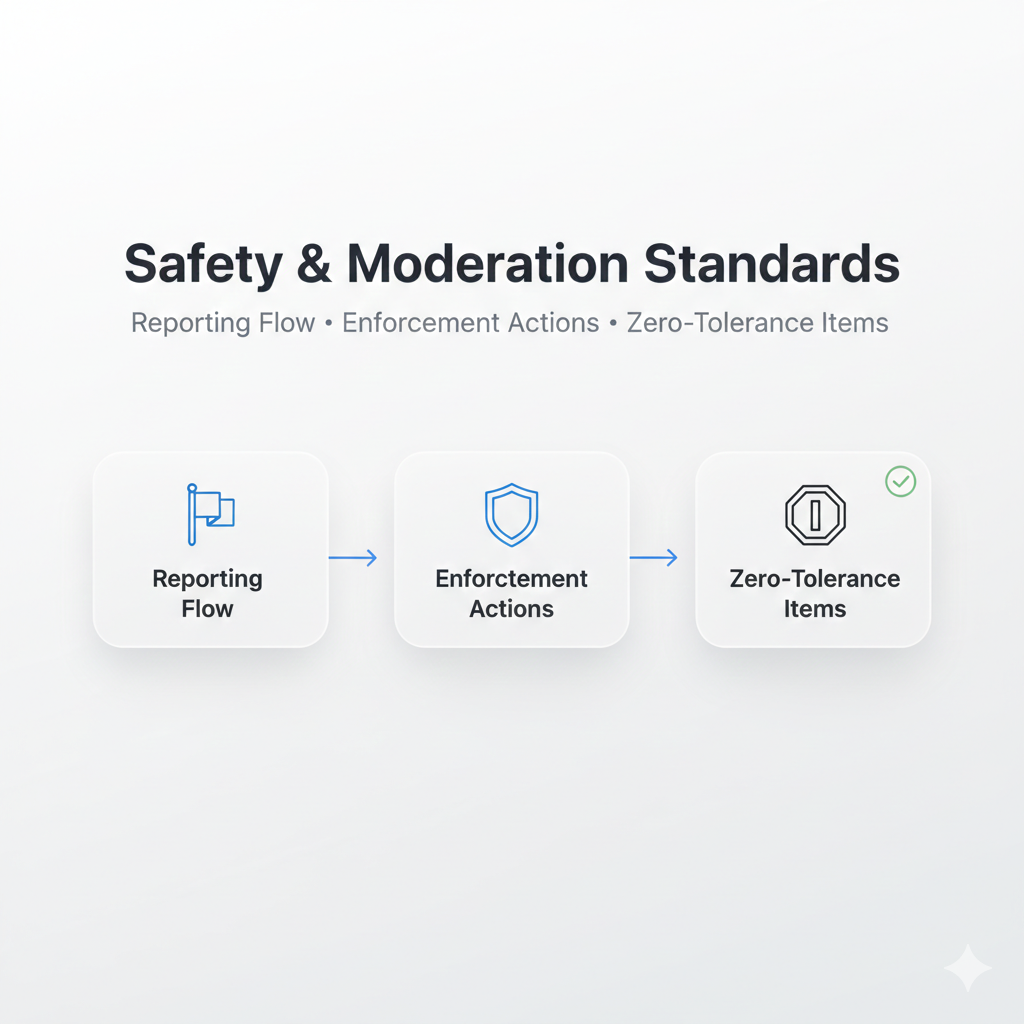
MyINC Social is designed as a controlled community platform, which means safety is not treated as an optional extra. This page explains how reporting works, what behavior can lead to action, how moderators review risk, why public standards matter, and how the platform aims to protect users, conversations, and long-term trust.

Structured reporting Context-aware review Proportional enforcement Zero-tolerance categories Appeals and correction
Safety and moderation standards on MyINC Social
Updated: March 19, 2026 Topic: Safety, Reporting, Moderation Audience: Users, Members, Reviewers Reading time: 9–11 minutes

Section 1

Overview

Safety and moderation standards define what conduct is acceptable, what conduct may be restricted, how reports are handled, and what enforcement may follow when behavior creates real risk. On MyINC Social, these standards can apply to posts, comments, direct messages, usernames, profiles, uploaded media, and broader account behavior patterns that appear deceptive, abusive, or unsafe.

These standards exist for a practical reason. When rules are vague, enforcement becomes inconsistent. When enforcement becomes inconsistent, bad actors learn how to test boundaries and ordinary users lose confidence that the service is being operated responsibly. Public standards help solve that by creating a visible reference point for users, moderators, reviewers, and anyone evaluating how the platform handles trust and safety.

Safety is not only about removing obviously bad content. It is also about preventing repeat abuse, reducing impersonation, discouraging manipulative conduct, lowering the burden on good users, and helping the platform remain stable as it grows. A serious platform cannot wait until conflict happens before explaining how it will respond.

For users

Clear standards make it easier to know what is expected, what may be reported, and what kinds of behavior can lead to warnings, restrictions, or removal.

For reviewers

Clear standards reduce guesswork and support more consistent decisions based on context, severity, repeat behavior, and actual platform risk.

Core idea: a safer platform does not happen by accident. It requires visible standards, usable reporting paths, structured review, and meaningful action when behavior crosses the line.

Section 2

Core moderation principles

These principles guide how moderation decisions should be approached across reporting, review, enforcement, escalation, and correction. They do not remove the need for judgment, but they reduce arbitrariness by giving that judgment a clearer structure.

Safety first

Urgent risks should move first. Credible threats, doxxing, extortion, coercion, or severe harassment should not wait behind low-risk complaints.

Consistency

Similar conduct should receive similar treatment. Without consistency, moderation becomes easier to challenge and easier to game.

Proportionality

Action should fit the seriousness of the conduct, the pattern behind it, and the likely risk to users or platform integrity.

Context matters

Single screenshots, isolated phrases, or clipped messages can be misleading. Review should consider the surrounding exchange where relevant.

Goal: protect users, reduce abuse, discourage bad actors, and keep the platform more respectful without turning moderation into improvisation.

Section 3

Why standards matter

Online communities are vulnerable to predictable failure points: spam, fake accounts, impersonation, repeated harassment, manipulative private messaging, privacy violations, and coordinated attempts to damage trust. Platforms that do not define their boundaries early usually spend more time reacting to preventable problems later.

A controlled community platform still needs strong safeguards. In some ways it needs them more. Limited access creates higher expectations. Users reasonably assume that a more protected environment will also take identity, conduct, moderation, and trust more seriously than a generic open social network. Public standards help support that expectation.

Safety standards also help outside reviewers understand that the platform is not operating without structure. Visible policy pages show that the service has thought through reporting, enforcement, appeals, and user protection in advance.

  • They reduce ambiguity by clearly identifying conduct that is not acceptable.
  • They support better decisions because reviewers are working from a framework instead of improvising from scratch.
  • They protect users by reducing exposure to abuse, impersonation, and manipulative behavior.
  • They improve accountability by making expectations visible rather than hidden.
  • They help the platform scale because growth without visible standards usually increases inconsistency and trust problems.

Section 4

User responsibilities

Safety standards are not only about what moderators do. They are also about how users behave. Every account holder plays a role in keeping the platform safer, clearer, and easier to manage. That means users should not only avoid direct violations, but also avoid conduct that creates confusion, increases risk, or turns reporting and review into noise.

What users are expected to do

Use the platform honestly, respect other users, protect privacy, use reporting tools responsibly, and cooperate with restrictions or corrections when they are applied.

What users should avoid

Impersonation, coordinated harassment, privacy violations, abusive messaging, deceptive reporting, ban evasion, and repeated attempts to test the same boundary after being warned.

  • Use the platform honestly: do not misrepresent identity, status, or authority.
  • Respect other users: disagreement is not the same as intimidation, targeted hostility, or sustained abuse.
  • Protect privacy: do not post private information, identifying details, or personal screenshots without a legitimate basis.
  • Use reports properly: reporting should surface real issues, not function as retaliation.
  • Respect restrictions: trying to evade moderation usually increases enforcement severity.

Section 5

Reporting flow

Reporting is one of the main ways harmful conduct enters the moderation system. Reports can apply to posts, comments, messages, usernames, profiles, uploaded media, or broader account behavior that appears deceptive, abusive, threatening, or unsafe. A reporting system matters because moderators do not always see the first signs of a problem directly.

Good reporting tools should be specific enough to help reviewers, but simple enough that normal users can use them without friction. A reporting system that is too vague creates noise. A reporting system that is too hard to use allows more harmful behavior to stay unreported.

01

Flag the content or account

A user reports the post, comment, message, or profile and selects the reason that best matches the concern.

02

Add supporting details

Extra detail, links, timestamps, or screenshots can improve review speed and reduce false positives.

03

Enter the moderation queue

The report is submitted for review. Higher-risk cases can be escalated ahead of ordinary disputes.

04

Review context and severity

Moderators may examine surrounding context, repeat patterns, evidence quality, and the likely credibility of the report.

05

Decision and action

If a violation is confirmed, the platform may remove content, warn the user, limit features, suspend the account, or apply stronger action.

06

Correction if needed

If new evidence appears or a mistake is identified, the case can move through the normal appeal or correction path.

Section 6

How reports are reviewed

Not every report carries the same urgency. A credible threat, extortion attempt, or doxxing report should not sit in the same queue position as a minor etiquette dispute. That is why moderation review is usually triaged by severity, confidence, supporting evidence, repetition, and likely impact.

Good triage is not about speed alone. It is about directing attention where the risk is highest first. A platform that treats every complaint as identical usually ends up either too slow on dangerous cases or too erratic on ordinary ones.

Priority level High for urgent safety risks, Medium for likely violations, and Low for cases that need more clarification or supporting evidence.
What may be reviewed Severity, credibility, surrounding context, account history, repetition patterns, evidence quality, and whether a person or group is being specifically targeted.
Why context matters Single screenshots, clipped messages, or isolated quotes can be misleading. Review should consider the broader exchange where relevant.
How evidence helps Clear links, timestamps, screenshots, and accurate descriptions usually improve review speed and reduce confusion.
Pattern review Moderation may consider whether the issue is isolated, repeated, coordinated, or part of a broader misuse pattern involving the same account or group of accounts.

Section 7

Enforcement actions

Enforcement should be proportional. A low-severity first offense should not be treated the same as repeated abuse, impersonation, extortion, threats, or coordinated misconduct. At the same time, some categories are serious enough to justify immediate strong action without a long warning ladder.

Enforcement exists to protect the platform and its users, not merely to punish. In many cases the correct response is removing harmful material, limiting harmful behavior, and preventing recurrence. Where the conduct is more serious, stronger account-level action may be required.

Content removal Posts, comments, messages, media, usernames, or profile elements that violate standards may be removed from visibility or access.
Warnings Warnings may be used for lower-severity or first-time issues where correction is appropriate.
Temporary restrictions Posting, commenting, messaging, or interaction limits may be applied for a defined period when conduct creates repeated friction or risk.
Feature limits Specific features may be restricted when misuse patterns are detected, even if the account is not fully suspended.
Temporary suspension Accounts may be blocked during review or after serious violations while a broader case is assessed.
Permanent removal Repeated abuse, serious deception, high-risk misconduct, or zero-tolerance violations can justify permanent account removal.